
How to Build a Toddler's Language Through Play: Why Toddler Puzzles Are One of My Favorite Tools
- karentspeech
- Jul 11
- 4 min read
When parents think about building language, they often picture flashcards, educational apps, or alphabet toys. But after more than 30 years as a speech-language pathologist, I can tell you that one of the simplest and most effective language-building tools is something you can often find for just a few dollars.
Toddler puzzles!!!!!

I own a lot of toddler puzzles, and they are some of the most versatile therapy materials I use. They encourage communication, attention, listening, turn-taking, vocabulary, and problem-solving, all while children think they're simply playing.
Not all puzzles are created equal.
For young toddlers and children who are just beginning to communicate, I recommend:
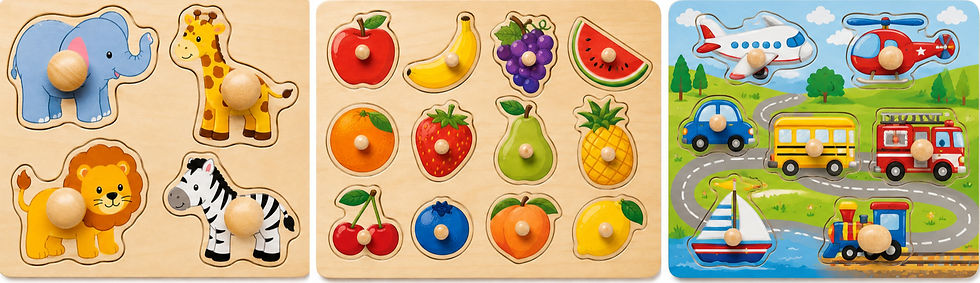
Wooden puzzles with large pegs or knobs that little hands can easily grasp
Individual pieces that lift out separately
Simple pictures with one object per piece
Some of my favorite themes include:
Farm animals
Zoo animals
Vehicles
Food
Bath time
Toys
Ocean animals
Pets
Dinosaurs
Here's one recommendation that surprises many parents:
Don't buy dozens of puzzles of the same type (even if your child is obsessed with dinosaurs or horses). Two or three puzzles for each theme are plenty. We want to grow your child's vocabulary!
If your child is not yet talking much, skip the alphabet, numbers, and color puzzles for now.
Letters and numbers are wonderful later, but they aren't usually the words young children need most. Children first need words they can use every single day:
dog
ball
shoe
car
apple
baby
fish
cow
These are words that help children communicate with the people around them.
Puzzles Build More Than Talking
One of the biggest misconceptions is that every activity has to make a child say words.
Actually, many children first need to understand words before they'll use them.
This is called receptive language - everything a child understands.
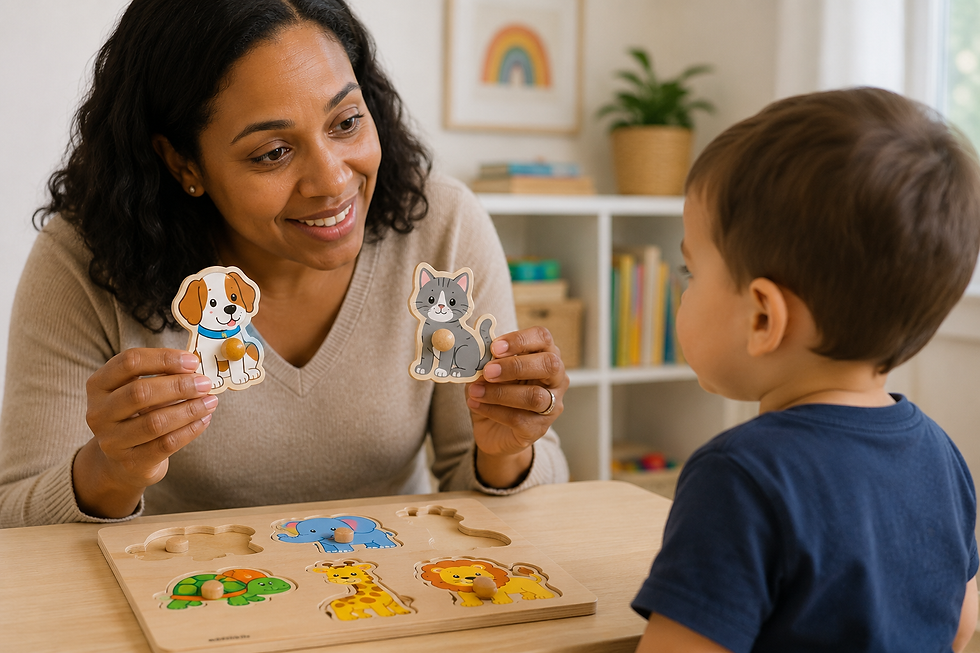
Every time you pick up a puzzle piece and say:
"Dog!"
or
"Cat!"
Your child is hearing vocabulary connected to a real object.
But don't stop there.
You can easily turn a simple puzzle into a powerful listening game.
Easy Ways to Build Understanding
Instead of asking your child to repeat words, try giving simple directions.
Hold up two puzzle pieces and say:
"Get the cow."
"Find the car."
"Give me the fish."
As your child improves, increase the number of choices.
Place several pieces on the floor and ask:
"Where's the apple?"
"Can you find the dog?"
"Show me the airplane."
These activities teach children to listen, process language, and connect words with meaning.
More Ways to Build Understanding
Instead of asking your child to repeat words, try giving simple directions.
Hold up two puzzle pieces and say:
"Get the cow."
"Find the car."
"Give me the fish."
As your child improves, increase the number of choices.
Place several pieces on the floor and ask:
"Where's the apple?"
"Can you find the dog?"
"Show me the airplane."
These activities teach children to listen, process language, and connect words with meaning.
Turn Clean Up into Learning Time
Most parents miss one of the best teaching opportunities...
Putting the puzzle away!
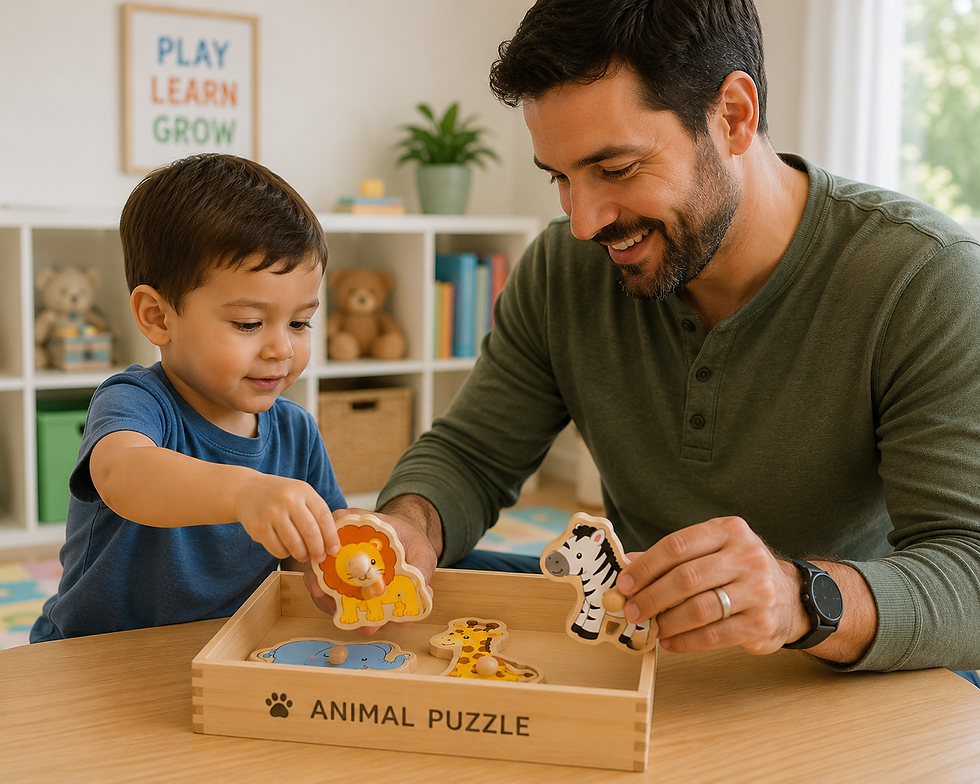
Instead of simply tossing pieces back into the box, continue practicing listening.
You might say:
"Get the pig."
"Find the bus."
"Put the shoe away."
As your child develops, make the questions a little harder:
Which one says moo?
Which one can fly?
Which one lives in the water?
Which one do you wear on your feet?
Which one can you eat?
Which one goes vroom?
Which animal is biggest?
Which one is yellow?
Now your child isn't just learning vocabulary, they're learning categories, functions, sounds, descriptive words, and critical thinking skills!
Follow Your Child's Lead
Here's one of the biggest mistakes I see adults make:
Insisting a child finish the entire puzzle before putting it away.
Please don't.
If a child is finished after two pieces, that's okay.
Maybe they will be interested in three or four pieces tomorrow and that's progress.
Children learn best when activities stay fun, not when they become a battle.
When we force children to keep going after they've lost interest, we often see:
crying
throwing pieces
refusing to participate
running away
frustration for everyone
That doesn't mean the child is being difficult.
It usually means we've asked for more than they can handle right now.
Meet them where they are.
Two pieces today.
Three tomorrow.
Five next week.
Little by little, attention grows naturally because play stays enjoyable.

My Favorite Therapy Secret
The goal isn't to finish the puzzle. The goal is connection.
Every puzzle piece becomes an opportunity to:
build vocabulary
strengthen listening skills
practice following directions
encourage joint attention
model language
take turns
celebrate success
And best of all...
Your child simply thinks they're playing.
Sometimes the simplest toys create the biggest learning opportunities.
So the next time you pull out a $5 wooden puzzle, remember:
You're not just doing a puzzle. You're building a foundation for language, one piece at a time.

Karen Taylor, M.S., CCC-SLP, CAS
Speech-Language Pathologist
Founder, Universal Speech Strategies
"Helping parents and professionals build communication through practical, evidence-based strategies."


Comments