Autism Resources for the Home
What Is Autism?
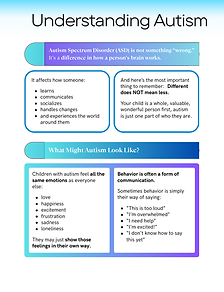
Autism, or ASD, is simply a different way the brain works. It affects how a person learns, communicates, plays, and experiences the world—but different doesn’t mean less.
Children with autism may:
-
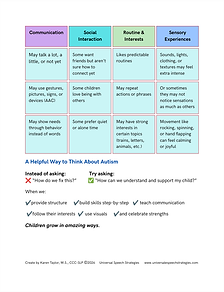
Communicate in many ways including speech, gestures, pictures, or devices.
-
Prefer routines and predictability.
-
Have strong interests or repeat actions they enjoy.
-
Be more or less sensitive to sounds, lights, textures, or movement.
-
Show feelings differently, but still feel everything: joy, frustration, love, sadness.
There’s no one “look” or “type” of autism. Every child is unique.

Try This at Home
Helping Your Child Communicate Every Day
Establish Consistent Routines
🎉Why It Helps:
-
Children with autism often find comfort in predictability and routine.
-
Consistent schedules help reduce anxiety and support a sense of security.
✨Putting it into practice:
-
Create visual schedules that outline daily activities, like meals, playtime, and bedtime.
-
These can be pictures or simple words that are easy for your child to follow.
-
Be consistent with routines, but also flexible when unexpected changes occur.
-
Acknowledge any disruptions and calmly explain what has changed to help your child adjust.
Use Clear and Simple Communication
🎉Why It Helps:
-
Many children with autism may struggle with verbal communication.
-
clear instructions can reduce frustration.
✨Putting it into practice:
-
Use short, direct sentences and avoid using abstract language.
-
Instead of saying, "Please put your toys away," try "Toys in the box."
-
For non-verbal children or those with limited speech, use pictures, sign language and/or gestures.
-
Give your child extra time to process instructions or requests.
Teach Through Strengths and Interests
🎉Why It Helps:
Children learn best when lessons connect to what they love. Interests help build attention, motivation, and joy.
✨Putting it into practice:
-
Use your child’s favorite characters, toys, songs, or activities during learning.
-
If your child loves trains, practice counting with train cars or practice language through train play.
-
Embed learning into play instead of only structured tasks.
-
Follow your child’s lead and they’ll show you what captures their interest.
Focus on Positive Reinforcement
🎉Why It Helps:
-
Reinforcing positive behaviors rather than punishing negative ones encourages more of the behaviors you want to see.
✨Putting it into practice:
-
Celebrate small successes with praise or rewards, whether it’s a high-five, a favorite activity, or a small token.
-
Positive reinforcement helps build your child’s
🌟 Quick Facts About Autism
-
Autism is a neurodevelopmental difference affecting how a person communicates, learns, plays and experiences the world.
-
Roughly 1 in 36 children in the United States are diagnosed with autism.
-
About 25-30% of autistic children are minimally verbal or do not develop spoken language
-
Around 80-90% of autistic children experience sensory differences, meaning they may be very sensitive (or not sensitive enough) to sounds, lights, textures, smells, or movement.
-
There is no “one way” a child with autism looks or behaves. Strengths, interests, challenges, and personalities vary widely from child to child.
Autism Myths and Truths
Myth: Autism is something a child will outgrow
Truth: Autism is lifelong, but children grow, learn, and develop new skills throughout their lives.
Myth: Children with autism don’t feel emotions the same way.
Truth: Autistic children experience the full range of emotions: joy, love, frustration, sadness, excitement, just like anyone else. They just might show it differently!
Myth: If a child uses sign language or pictures, they won’t learn to talk.
Truth: Research shows the opposite. AAC supports and encourages speech development for children who will learn to talk, and it gives all children a way to communicate now.
Myth: Autism is caused by bad parenting or vaccines.
Truth: Autism is not caused by parenting style or vaccines. It is a neurodevelopmental difference in how the brain develops and processes information.
Like What You Read?
Download Your Free Printable


Why Visuals Matter at Home
Visuals give children with autism a clear, predictable way to understand their world. When you use pictures, schedules, and simple symbols throughout your day, you’re offering a powerful communication tool that reduces stress, builds independence, and helps your child follow routines with confidence.
Visual supports turn everyday moments like getting dressed, transitioning between activities, or making choices into opportunities for success.



Handwashing Routine
This visual shows the steps to complete the handwashing routine. Teaching the routine by using visuals increases your child's ability to be independent.


Bring these ideas to life with these free printables!

Frequently Asked Questions
When a child is diagnosed with autism, it’s natural for questions to pop up one after another. Here are some helpful answers to the most common questions to guide and encourage you.
1. What exactly is Autism?
Autism (Autism Spectrum Disorder or ASD) is a difference in the way a person’s brain works.
It affects how someone:
-
learns
-
communicates
-
socializes
-
handles changes
-
experiences the world
Some children love:
-
being social, others prefer quiet time
-
speak with words, others use gestures, pictures, or devices
-
enjoy routines and repetition
-
have strong interests
-
are extra sensitive (or less sensitive) to sounds, lights, or touch move in ways that help them feel calm (rocking, spinning, hand flapping, tiptoes)
Different does not mean less.
2. What causes Autism?
Autism is caused by a combination of genetics and environmental factors that affect how the brain develops.
Researchers know:
-
It often runs in families
-
Many genes affect how brain cells connect and communicate
-
Things like prematurity or older parents may increase risk
-
Very important:
🚫 Parents do NOT cause autism
🚫 Autism is NOT a punishment or curse
🚫 Vaccines do NOT cause autism
Dozens of studies show no link between vaccines and autism. Autism is often noticed around 18–24 months which is around the same time some vaccines happen, but timing does NOT mean cause.
3. Why are the number of cases of autism rising?
Autism isn’t necessarily rising, we’re just better at recognizing it.
Today:
-
The definition is broader
-
Professionals understand autism better
-
Girls and underserved groups are being identified more often
-
Children with other diagnoses are also being screened
-
More premature babies survive
-
Parents and teachers know what signs to look for
Many kids who used to be labeled “different” now receive helpful support.
4. Can autism be cured?
Autism is not a disease, so it doesn’t need a cure. It is a lifelong brain difference.
But here’s the hopeful part: Children with autism absolutely CAN learn, grow, and make progress.
There is no “one treatment.”
Support is individualized and may include:
-
speech therapy
-
occupational therapy
-
behavior supports
-
visual supports
-
communication tools
-
parent coaching
The goal isn’t to “fix” your child, it’s to support their strengths and help them thrive.
5. What are the signs of autism?
Every child is different, but signs often fall into these main areas:
Social & Communication
-
Limited back-and-forth conversation
-
Difficulty reading body language
-
Trouble making friends
-
Avoiding eye contact
-
Delayed speech or unusual tone
-
Not responding to name or directions
Repetitive Behaviors & Interests
-
Hand flapping, rocking, spinning
-
Lining up toys
-
Very focused interests
-
Prefers routines, struggles with change
Sensory Differences
-
Sensitive to sounds, lights, smells, textures
-
Or doesn’t notice sensations as much
Development & Movement
-
Language delays
-
Movement delays
-
Anxiety or strong reactions
-
Very high or very low fear responses
If you notice several of these signs, talk with your pediatrician or a specialist.
Download this reference guide to common questions!


Understanding Echolalia & Gestalt Language Processing
One of the questions I hear most often from parents is, "How do I stop my child from repeating everything I say?"
My answer usually surprises them. The goal isn't to stop the repetition (commonly called echolalia) - it's to understand it. Once we understand why a child is repeating words or phrases, we can begin teaching more flexible, independent communication while recognizing that the repetition itself often serves an important purpose.
Many parents have also heard the term Gestalt Language Processor (GLP) or have been told their child may be one. This can raise even more questions. What is echolalia? What is Gestalt Language Processing? Are they the same thing? And most importantly, how can you best support your child's communication?
If all of this feels overwhelming, you're not alone. Let's start with the basics and build from there.
What is Echolalia?
Echolalia is a behavior (repeating words or phrases).is the repetition of words, phrases, or sentences that a child has heard before.
A child may repeat language:
-
Immediately after hearing it
-
Hours later
-
Days, weeks, or even months later
Examples:
-
Parent says, "Do you want juice?" Child repeats, "Want juice?" or "Do you want juice?"
-
Child watches a favorite show and later says a line from it.
-
Child repeats a teacher's instructions word-for-word.
Many people assume echolalia is meaningless repetition, but research and clinical experience show that echolalia often serves a purpose.
A child may use echolalia to:
-
Communicate a want or need
-
Answer a question
-
Regulate emotions
-
Process language
-
Request something
-
Answer questions
-
Self-talk during play
-
Fill conversational gaps
-
Practice speech and new words
-
Express emotions
-
Maintain social interaction
Examples that are probably NOT GLP:
Immediate echolalia:
Adult:
"Do you want juice?"
Child:
"Do you want juice?"
The child may simply be:
-
processing the question
-
needing extra time
-
not knowing how to formulate an answer
Delayed echolalia:
Parent:
"Time for bed."
Child:
"To infinity and beyond!"
The child may simply enjoy repeating favorite movie quotes.
What research says:
✅ Echolalia is common in autistic children.
✅ Echolalia often has meaningful communicative functions.
✅ It should generally be interpreted rather than suppressed
What is Gestalt Language Processing?
Gestalt Language Processing (GLP) is a way some children learn language.
Instead of learning language one word at a time, they learn larger chunks or "gestalts" of language first.
A child who is a gestalt language processor may store and use:
-
Entire phrases
-
Song lyrics
-
TV scripts
-
Frequently heard expressions
-
Phrases from favorite shows
-
Long scripts before using single words
-
Repeat questions instead of answering them
-
Use the same phrase in multiple situations
-
Seem to communicate in chunks rather than individual words
-
Mix portions of familiar phrases together
For example:
Instead of learning words as a single unit like:
-
want
-
cookie
They might first learn
"Do you want a cookie?"
"To infinity and beyond!"
"Just keep swimiming"
The child learns these as a single unit, almost like one vocabulary word.
Later they gradually break it apart into:
-
want cookie
-
want juice
-
want Mommy
-
I want cookie
This progression is central to the GLP model.
Although these phrases may sound advanced, the child may not yet understand the meaning of each individual word within the phrase. Instead, the entire phrase has been learned and stored as one unit.
Think of it like learning a song. You can sing the whole song without necessarily understanding every individual word.
I encourage emphasizing that the most important question isn't whether a child "is a GLP", it's understanding what the child is communicating and providing language support that matches their current abilities. Keep the focus on functional communication rather than on assigning a particular label.
Many children gradually move from memorized scripts to self-generated language over time.
Instead of asking:
"Why is my child repeating that?"
Ask:
"What might my child be trying to communicate?"
That shift often helps parents better understand their child's communication attempts.

In my experience working with autistic children, parents are often told that echolalia is something that needs to be "stopped." I encourage families to view echolalia differently. Repeated phrases often give us valuable clues about what a child understands, enjoys, needs, or is trying to communicate. Whether a child is a gestalt language processor or simply using echolalia as part of language learning, the goal is not to eliminate communication attempts. The goal is to understand the message behind the words and help the child build increasingly flexible and meaningful communication skills over time.
Feelings, Emotions & Learning to Calm
Big feelings can be hard to manage
All young children are still learning how to recognize, understand, and manage their emotions. For children with autism, this process may be especially challenging.
A child may experience an emotion very strongly but not yet have the language, body awareness, or coping skills to communicate:
“I’m frustrated.”
“This is too loud.”
“I don’t know what is happening next.”
“I need a break.”
“I need help.”
Instead, adults may see crying, yelling, running away, dropping to the floor, pushing materials away, becoming very quiet, or refusing to participate.
Rather than looking only at the behavior, ask: What might my child be communicating right now?
Why Can Emotional Regulation Be Difficult?
Young children with autism may have difficulty recognizing what they are feeling, noticing the early signs that they are becoming overwhelmed, communicating what they need, or knowing what to do to help their bodies feel calm again.
Sensory differences can also play an important role. Sounds, lights, crowds, clothing, smells, unexpected touch, hunger, fatigue, or a busy environment may feel much more intense to some children.
Changes in routines and unexpected events can add another layer of stress. A situation that seems small to an adult, taking a different route home, turning off the tablet, wearing different shoes, or discovering that a favorite snack is unavailable, may feel very significant to a child who depends on predictability.
The goal isn't to stop children from having big feelings. The goal is to help them recognize those feelings, communicate their needs, and gradually develop strategies that help them feel safe and regulated.
How Parents Can Help
Name Feelings During Everyday Moments.
Help your child connect words with emotions
throughout the day.
“You look excited!”
“That was frustrating.”
“You’re disappointed that playtime is finished.”
“That noise surprised you.”
Keep the language simple and avoid requiring your child to tell you how they feel. Hearing adults model emotional vocabulary helps children begin making those connections.
Notice the Early Signs
Calming strategies work best before a child becomes completely overwhelmed.
You may notice your child beginning to pace, cover their ears, become quieter, repeat words or movements, move more quickly, complain, push things away, or seek more sensory input.
Over time, learning your child's early signals can help you offer support sooner.
Teach Calming Strategies When the Child is Calm
Don't wait for a meltdown to introduce a new strategy.
Practice breathing, stretching, taking a break, counting, or using a calm space during relaxed moments.
Make it playful and practice together.
When a strategy becomes familiar, your child is more likely to recognize and use it when emotions begin to build.
Use Visual Supports
When children are overwhelmed, understanding spoken language can become more difficult. A simple visual can show a child what choices are available without adding more verbal demands.
Try a visual such as:
Things I can do to calm down poster
I need a break card
Practice Simple Breath Exercises
Breathing activities can give children a concrete action to practice while slowing their bodies down.
Try:
Star Breathing
Trace around a star while slowly breathing in and out.
Birthday Candle Breathing
Take a slow breath in, then gently blow out as though
blowing out a birthday candle.
Balloon Breathing
Imagine the belly filling like a balloon while breathing in
and slowly getting smaller while breathing out.
Hand Tracing Breathing
Trace up each finger while breathing in and down each finger
while breathing out.
Try a Grounding Strategy
For children who can understand the activity, grounding can help shift attention toward what is happening around them.
Try 5-4-3-2-1 Grounding:
5 things I can see
4 things I can touch
3 things I can hear
2 things I can smell
1 thing I can taste
Keep the activity supportive rather than requiring the child to complete every step.
Create a Calm Space, Not a Punishment Space
A calm corner can provide a predictable place where a child can go when they need less stimulation or additional support.
Consider including a comfortable seat or pillow, books, a stuffed animal, sensory materials, headphones, calming visuals, and a few familiar regulation activities.
Most importantly, the space should never be used as punishment.
A calm space communicates:
“You are safe. You can take the time you need.”
Download your Calm Down Poster!
Download Your 4 Free Breathing Posters on the Freebies Page!


Download a 5-4-3-2-1 Grounding Visual for Your Home!

Download your "I need a break" cards!

Co-Regulation Comes Before Self-Regulation
Young children don't learn to manage big emotions simply because adults tell them to “calm down.”
They learn through repeated experiences of being supported by calm, responsive adults.
Sit nearby. Lower your voice. Reduce unnecessary language. Model the strategy. Give the child time.
Reduce sensory demands when possible.
Instead of repeatedly saying:
“Calm down.”
Try:
“I'm here.”
“You're safe.”
“Let's take a break.”
“Your body needs some quiet.”
“Let's breathe together.”
With practice and support, children can gradually build a toolbox of strategies that work for their individual bodies and needs.